top of page
Search

Murray Sinclair's Legacy

pascalefournier
Nov 5, 2024
3 min read
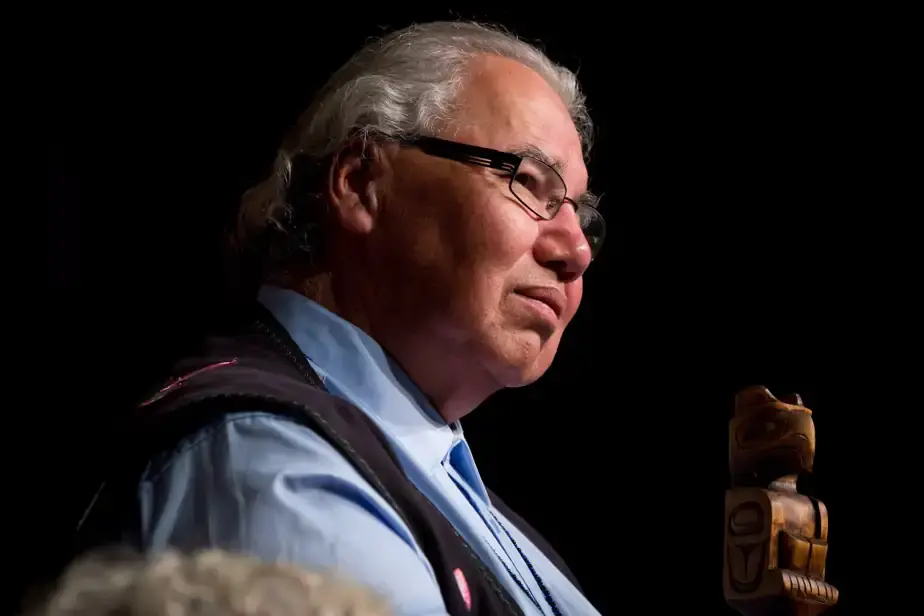
PHOTO DARRYL DYCK, ARCHIVES LA PRESSE CANADIENNE

Murray Sinclair chaired the Truth and Reconciliation Commission on residential schools, whose final report was released in 2015.


The former Manitoba senator and chair of the Truth and Reconciliation Commission died on November 4. Civil law professor Pascale Fournier pays tribute to his work and expresses the hope that it will be carried forward.

What matters most is the path. The path already travelled and the one still to come, no less noble. Today is the day after your death. After your passing. You are no longer, Murray Sinclair. You, that giant of history. With your piercing, extravagant gaze.

That gaze you left in each of us, like a necessary nonchalance, a stance that does not die, that cannot die. "The journey travelled is as important as the destination sought. There are no shortcuts. When it comes to truth and reconciliation, we are forced to walk the road," you told us. You pierced our hearts. With your mirroring effect, immediate and impossible to avoid: that elegance in naming what is ugly through an open palm, extended toward the other, a trembling hand, and yet an inviting one.

Under your leadership, the Truth and Reconciliation Commission heard 6,000 witnesses, most of them survivors of the residential schools.

They spoke of pain, of identity torn apart, of the loss of geographic and linguistic bearings, of rage and silence, of fear and resignation, of injustice and intergenerational trauma, of death both real and anticipated.

To set down that speech, first. To honour that truth, next. Then, to reconcile for the future. "Knowing the truth was hard, but reconciling will be harder still," we read in the preface to the Commission's report. You warned us, Murray Sinclair. With speech unshackled and now free, a point of no return takes shape: a depth in the way we meet one another, a different way of looking at each other, of seeing ourselves through the other. Reconciliation is born of that power, of that quiet strength.

"When the school is on the reserve the child lives with its parents, who are savages; he is surrounded by savages, and though he may learn to read and write his habits, and training and mode of thought are Indian. He is simply a savage who can read and write."
The blunt words of Canada's Prime Minister, Sir John A. Macdonald, spoken in the House of Commons in 1883 and reproduced in the introduction to the Commission's report.

Sometimes no word should be banished. For censorship is complicit with history. So we reproduce the words that kill, knowing full well that we are taking a risk. We hide nothing of the shadow that dwells in us and precedes us. Truth deserves to be given all the room it needs. But truth also knows that everything remains to be built from here. Mutually. Respectfully.

Ninety-four calls to action. A gravity. An ascent. Ninety-four calls that reach into education, language, culture, justice, history, commemoration, health, and training in reconciliation. Ninety-four calls that speak to us as citizens, because they demand that we rethink the very structures that carry our movement.

The pact of glaciers that melt on touching one another, transform, become liquid. To be that water which will follow whatever course we trace for it, "in order to redress the legacy of residential schools and advance the process of reconciliation."

Holding the federal government, the provincial and territorial governments and Indigenous governments accountable. That is Murray Sinclair's legacy, nationally.

But there is more, and there is better. Murray Sinclair's leadership on reconciliation was such that it crossed borders and called forth a culture of accountability even on the international stage. On October 29, 2024, the United Nations Committee on the Elimination of Discrimination against Women released its report on Canada: "Despite amendments to the Indian Act, gender discrimination against Indigenous women and girls persists in Canada."

A series of recommendations followed, notably amendments to the Indian Act that would allow women and children who historically lost their Indigenous status to reclaim it.

That too is Murray Sinclair's legacy. The courage to go all the way. To take up the torch and keep it burning as long as the half-light persists, however faint, however surrounded by progress.


  • White LinkedIn Icon
  • White Facebook Icon
  • White Instagram Icon

©2026 by Pascale Fournier 

« Democratizing knowledge means cultivating a real impact on populations who, in turn, generate social change. » 

bottom of page